
The Internet of Things promised industries eyes and ears everywhere — a sensor on every pump, a camera on every line, a buoy on every pond. That promise mostly got delivered. What didn't automatically follow was the thinking. A decade into industrial IoT, most operators we talk to have more data than they've ever had and roughly the same number of people staring at dashboards trying to decide what it means. The sensors were never the hard part. Turning a stream of numbers into a decision, in time for the decision to matter, is.
That's the actual promise of AI plus IoT, and it's different from either technology on its own. IoT alone gives you visibility. AI alone has nothing to reason about without real-world data flowing into it. Put them together — engineered together, not bolted side by side — and you get something neither delivers alone: systems that notice a problem before a person would, and tell you what to do about it in language a person can act on immediately.
Why IoT plateaus without AI
We've spent over a decade building IoT and IIoT systems before "AI" was part of the conversation, and the pattern was consistent across every industry we touched: the sensor rollout is the easy 20%. The hard 80% is what happens after the data starts arriving. A farm with soil moisture sensors in every plot still needs someone to check twelve dashboards and decide which plot needs water today. A factory with vibration sensors on every motor still needs an engineer to notice the one reading that's drifting out of range, three weeks before it would have shown up as a failure.
Without a layer that can watch that data continuously and flag what actually matters, more sensors just means more noise to sort through manually — an operations team's attention doesn't scale the way sensor deployments do. That's the ceiling IoT hits on its own, and it's exactly the ceiling AI is suited to break through: pattern recognition across time, at a scale and consistency no team of humans watching dashboards can sustain.
What actually changes when AI is layered onto IoT
The shift isn't abstract. It shows up as four concrete capabilities that raw sensor data doesn't have on its own:
- Anomaly detection that doesn't need a threshold set by a human. Fixed thresholds ("alert if temperature exceeds X") miss the slow drifts and unusual combinations that actually predict failure. Models trained on historical sensor behavior catch the pattern, not just the breach.
- Prediction, not just monitoring. A dashboard tells you what happened. A model trained on the same data can tell you what's likely to happen in the next six hours, or the next two weeks — the difference between reacting and getting ahead of it.
- Plain-language recommendations instead of raw readings. "Soil moisture in Plot 4 is 18% below optimal" requires interpretation. "Irrigate Plot 4 tomorrow evening to avoid crop stress" doesn't. That translation is where a lot of the practical value sits, and it's squarely an AI problem, not a sensor problem.
- Cross-source correlation. A single sensor reading rarely tells the full story. A model that reasons across soil data, weather forecasts, and historical yield simultaneously catches things no single feed would reveal on its own.
What this looks like in the field
This isn't theoretical for us — it's the direction our own product line has moved, because it's the same pattern we saw across every industry we've built IoT systems for:
Agriculture — AgriSense
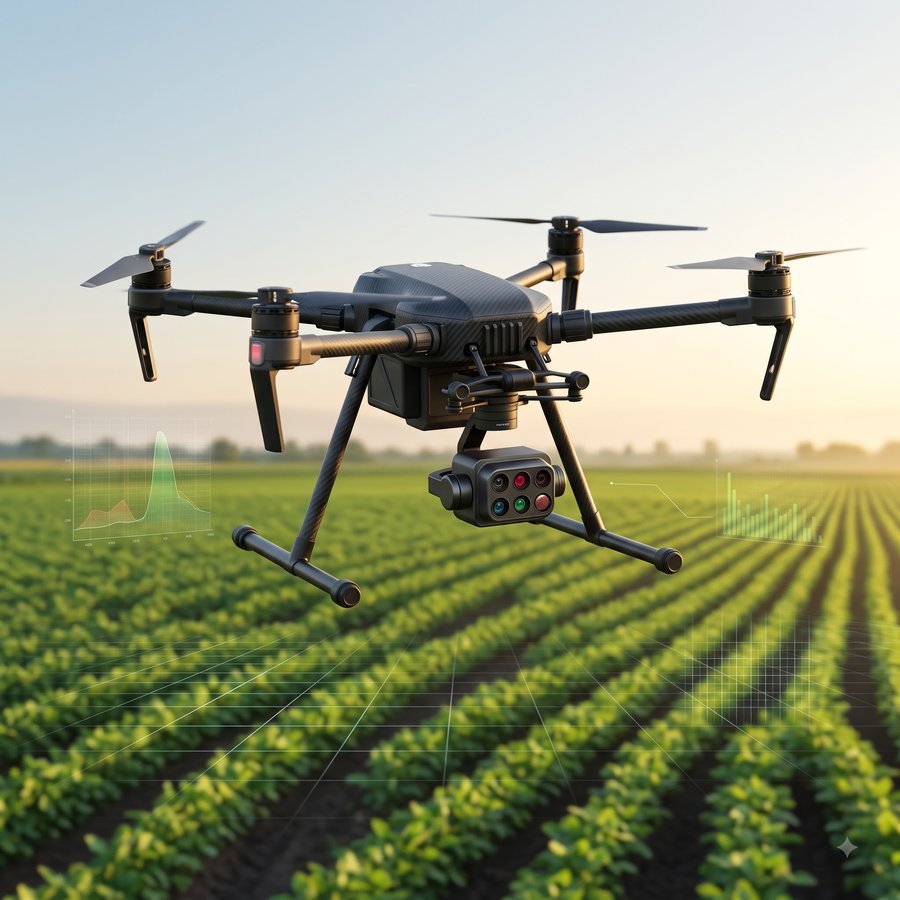
AgriSense combines multispectral drone imaging, ground sensors, and weather stations with models that turn raw vegetation and soil data into specific guidance — flagging early signs of crop stress or disease from imaging data days before it's visible to the eye, and translating sensor readings into concrete irrigation and fertilizer timing instead of leaving a farmer to interpret a chart.
Aquaculture — AquaSense
In open-pond and RAS aquaculture, water quality can shift dangerously fast, and by the time a manual check catches it, stock may already be stressed. AquaSense pairs continuous water-quality sensing with models that learn the normal rhythm of a given pond or tank, so a deviation gets flagged as it starts — not after someone happens to check the reading.
Manufacturing — FactorySense
Vibration, temperature, and performance sensors on industrial equipment produce far more data than any maintenance team can review by hand. FactorySense applies machine learning to that stream specifically for anomaly detection — catching the early signature of a bearing wearing out or a motor drawing abnormal load, well before it becomes unplanned downtime.
Energy — SolarSense and WindSense
A multi-site solar or wind portfolio generates a constant stream of performance data across dozens of assets. SolarSense and WindSense go beyond traditional SCADA monitoring to apply root-cause analysis and generation forecasting — turning "this inverter's output dropped" into "this inverter's output dropped because of this specific fault, here's the likely cause" and turning historical generation data into a day-ahead forecast operators can actually plan around.
Smart buildings — BMS
A building generates a constant stream of HVAC, occupancy, and energy data that most facilities teams only look at when something's already wrong. Applying the same sense-analyze-predict discipline to that data is what turns a building management system from a reactive control panel into a system that catches inefficiency and equipment strain before they show up on a utility bill or a service ticket.
Every one of these started as an IoT problem: get reliable data out of a physical environment. What made them worth building as products was the layer on top — the part that decides what the data means and what to do about it.
What it actually takes to build this well
Combining AI and IoT is a different engineering discipline than building either one alone, and it's where most attempts run into trouble:
Edge versus cloud is a real design decision, not a default
Not every decision can wait for a round trip to the cloud. A safety-critical anomaly on a factory floor may need to be flagged in milliseconds, at the edge, while a seasonal yield forecast can comfortably run as a nightly batch job in the cloud. Systems that default to "send everything to the cloud" either introduce latency that defeats the purpose, or run up bandwidth and infrastructure costs that make the whole system uneconomical at scale.
Sensor data is messy in ways clean training data isn't
Real field sensors drift, drop connections, and produce noise that a model trained on tidy data will misread as signal. Building for production means building in calibration, gap-handling, and outlier filtering as first-class parts of the pipeline — not an afterthought once the model "works" on a clean sample.
Intermittent connectivity is the normal case, not the edge case
A sensor on a remote farm plot or an offshore buoy won't always have a reliable connection. Systems designed only for the always-connected case fail exactly where IoT deployments are often most valuable — in the field, not the data center.
The AI layer is only as good as the integration underneath it
A model that generates a perfect recommendation is worthless if that recommendation doesn't reach the irrigation controller, the maintenance ticketing system, or the operator's phone at the moment it matters. This is the same systems-integration discipline that has nothing to do with model quality and everything to do with whether the recommendation actually reaches a person or a system that can act on it.
Where to start
The organizations getting real value out of AI and IoT together aren't instrumenting everything at once and hoping insight follows. They're starting where the pattern is clearest:
- Find the sensor data you already have that someone is manually reviewing today — a dashboard someone checks every morning, a report someone compiles every week.
- Apply anomaly detection or prediction there first, rather than building a new sensing layer from scratch. The fastest path to value is usually adding intelligence to data you're already collecting.
- Close the loop, not just the alert. A model that flags a problem is only half the system. Design for the recommendation to reach the person or system that acts on it, or the value stops at the dashboard exactly like it did before.
- Design for the field, not the demo. Build for intermittent connectivity, sensor drift, and edge cases from day one — they're not exceptions in industrial IoT, they're the normal operating condition.
IoT gave industries the ability to see what's happening in real time. AI is what lets them act on it before it becomes a problem instead of after. Built separately, they're two dashboards. Built together, with the same engineering discipline either one demands on its own, they're the difference between an industry that reacts and one that gets ahead.